
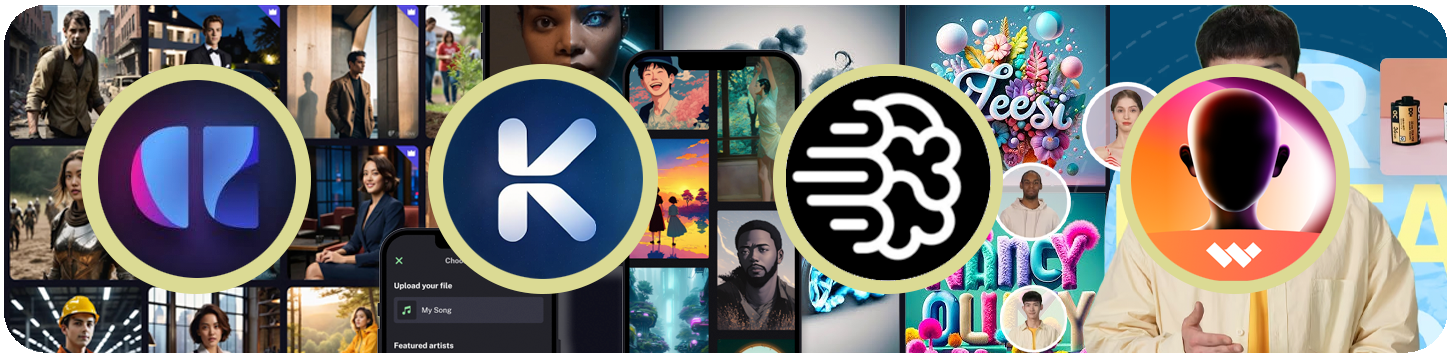
In the dynamic world of design, innovation is constant. The last few months have brought with them a torrent of new tools and functionalities that are revolutionizing the way we work. And at the center of this transformation is, inevitably, Artificial Intelligence (AI). The tools that have caught our attention lately are: Artflow creates a character from several images of a subject and allows you to change pose, clothing and scenery. Kaiber creates variations of the same image in different styles. Ideogram generates images from prompts, but stands out in those that include text, where the rest, for the moment, fail. Virbo lets you choose from among its 350 hyper-realistic spokespersons and 400 natural voices the one best suited to narrate the content of your videos.
AI is not coming to replace designers, but to empower them.
It is understandable that fears arise in the face of the irruption of AI in the creative field. However, far from being a threat, AI is a powerful ally for designers working in communication agencies. It is not coming to take away our work, but to optimize our workflows and free us from repetitive tasks so that we can focus on what really matters: creativity and strategy.
Superpowers for creativity: AI as an extension of our capabilities
New AI-powered design tools offer a range of possibilities previously unimaginable. From automatically generating images from textual descriptions, to expanding and modifying photographs with astonishing realism, AI allows us to explore new ideas and concepts with astonishing speed. Take, for example, the generation of design variations. Before, creating multiple options for a client required a considerable investment of time and resources. Now, with the help of AI, we can quickly generate a broad spectrum of alternatives, allowing us to explore different styles and approaches in a matter of minutes. Another clear example can be found in the automation of tedious tasks, such as removing backgrounds or selecting complex objects. AI performs these tasks with pinpoint accuracy, freeing us from time-consuming manual work and allowing us to concentrate on the creative direction of the project. Rather than seeing AI as a substitute, we should understand it as an extension of our capabilities. It provides us with tools that enable us to be more efficient, productive and creative. It helps us overcome technical limitations and explore new frontiers in design.
Concrete innovations that transform the workflow
Recent innovations are palpable and transform everyday design practice. A prime example is Adobe’s Project TurnTable. This revolutionary technology allows us to take a flat vector image and, thanks to AI, generate an interactive 3D representation. This means we can rotate the image and view it from any angle, offering a completely new perspective and making it easier to visualize complex products or designs. This capability opens up a world of possibilities for product presentation, interface design and interactive content creation. Another significant enhancement is found in Photoshop’s Generative Fill. This tool, powered by Firefly, has evolved considerably. Now, it not only fills empty areas of an image with coherent content, but also allows you to extend images in a natural way, adding elements that integrate seamlessly with the original scene. In addition, improvements in the accuracy and consistency of the generated content make the results even more realistic and professional. We can remove unwanted objects, extend backgrounds, and even generate variations of the same object with amazing results, all with just a few clicks.
Beyond automation: AI as a catalyst for innovation
AI not only helps us work faster, it also pushes us to think differently. By automating repetitive tasks, it frees up our time to explore new ideas and approaches. It allows us to experiment with styles and techniques that were previously too laborious to implement. In addition, AI provides us with valuable information about design trends and user preferences. By analyzing large amounts of data, it can identify patterns and trends that help us make more informed design decisions and create more effective content.
The future of design: a symbiosis between human creativity and artificial intelligence
In short, AI will not take our jobs. It will give us superpowers. It will allow us to do more work in less time, with greater precision and with even more impactful results. The future of design is not a future without designers, but a future with AI-powered designers, capable of taking creativity to new heights. As a communications agency we celebrate this evolution and prepare to take full advantage of the opportunities that artificial intelligence brings us, integrating these tools into our workflows to offer our clients innovative and cutting-edge solutions. The key is symbiosis: human creativity, intuition and strategic thinking, combined with the power and efficiency of AI.