
We live in the age of immediacy. TikToks and 15-second reels, YouTube videos with timestamp to get “straight to the point”; newsletters that promise to “sum it all up in 5 sentences”.
We have become accustomed to consuming information at full speed, but do we really retain anything? We move from one post to another, from one video to another, without really processing what we are seeing.
This is a big challenge for communication and marketing. Because if you don’t capture attention in the first 3 seconds, you lose it. And if you only focus on the immediate, your message will dissolve in the maelstrom of content.
Attention span is at a minimum
It’s not just a perception. Our attention span has decreased in recent years. A University of California study revealed that in 2014, the average attention span on a screen was 2.5 minutes, while in 2023 it had dropped to just 47 seconds.
What has changed?
1. Saturation of stimuli: we have access to too much information at all times. Social networks, notifications, emails, streaming platforms? Everything competes for a few seconds of our attention.
2º Digital multitasking: we jump between tabs, we answer messages while watching a video, we read headlines without finishing articles. We do not delve into anything.
3º The reward of the immediate: our brain has learned that fast and easy is ‘better’. If a video takes a long time to engage, we move on to the next one. If a text is not attractive at first glance, we ignore it.
But this not only affects content consumption. It also impacts productivity, creativity and the ability to reflect. We find it hard to concentrate on a single task without distractions, and this has consequences on a personal and professional level.
How brands can capture (and keep) attention in this environment
In this context, communication and marketing strategies face the challenge of capturing and maintaining the attention of an audience with a diminishing capacity for concentration.
In addition, immediacy has become a standard expectation. Consumers demand quick responses and content that fits their fast-paced lives. This has led brands to tailor their messages to be concise, direct and highly engaging from the first second.
Brands must adapt to this new scenario of constant distraction. But the key is not only to capture attention, but to make the message stick.
- Brief, but with value
It’s not just about cutting information, but making it more effective. A clear and direct message has more impact than a long and confusing one.
In 2022, Duolingo launched a campaign on TikTok with videos of less than 10 seconds where its iconic mascot made jokes and viral challenges. The result was more than 5 million interactions in a few weeks, with short content, but with real engagement .
- Structured and visual
Well-organized text facilitates reading and retention. Using subheadings, lists and short paragraphs helps the message to be understood at a glance.
Netflix doesn’t just promote its series with trailers. It uses impactful images, one-line summaries and clear calls to action.
- Authentic storytelling
Stories connect more than cold data. A message that excites is much harder to ignore.
Nike doesn’t sell shoes, it sells self-improvement. Its campaigns tell the stories of real athletes, rather than just focusing on the product.
- Content customization
We don’t all consume information in the same way. What works on TikTok may not work on LinkedIn. The key is to know your audience and adapt your message according to the context.
Each year, Spotify Wrapped turns cold data into personalized experiences. Users receive a unique summary of their year in music, generating massive engagement .
- Encourage interaction
Passive content is quickly forgotten. If the user participates, he gets involved and remembers the message better.
Instagram polls, TikTok challenges or open-ended questions on LinkedIn make users stop, think and engage. And that increases message retention.
Make content that matters
The solution is not simply to make content shorter, but rather to make content that matters.
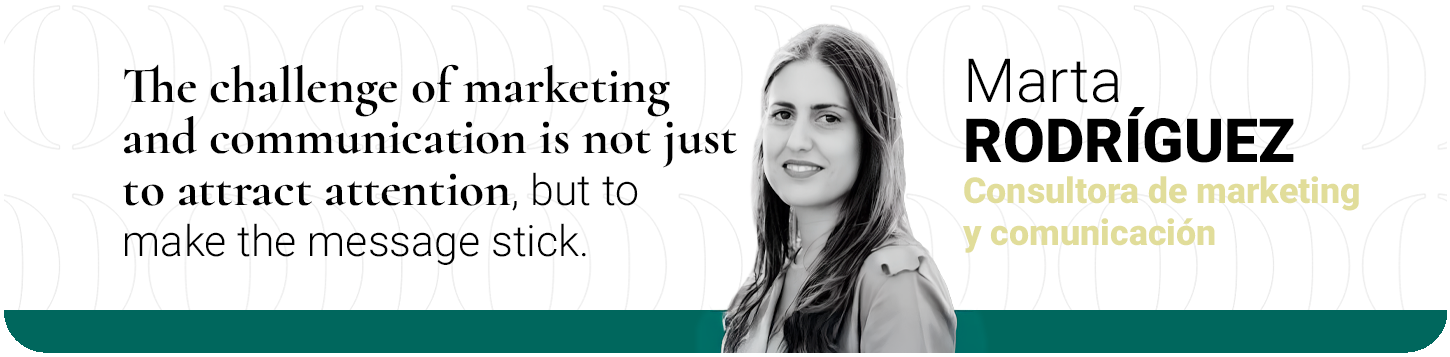
The challenge of marketing and communication is not only to attract attention, but to make the message stick. And for that, it is not enough to make shorter or flashy content, you have to set goals to achieve results:
Less noise = more impact.
Less speed = more value.
Less distraction = more connection.
The urgent need to recover our attention span
But the problem of inattention does not only affect digital communication. It also affects us on a personal and professional level. We find it hard to concentrate on long tasks, read books without interruptions or simply be really present in the moment we are living.
And, then, what can we do to regain some control?
Try to achieve moments of digital disconnection and avoid constantly consuming fragmented content.
Reading without distractions can help you train your concentration. Doing tasks one at a time while avoiding multitasking makes it easier for you to practice mindfulness.
Choose consciously what you want to see and read, instead of being driven by the algorithm. It is a way to consume content with purpose.
In short, pay attention to what you do, how you do it and what you do it for.
*Article written by Marta Rodríguez, marketing and communication consultant.