

We live in the information age and, paradoxically, it has never been so difficult to communicate. Hyperconnectivity, artificial intelligence, the glut of digital stimuli and the constant transformation of media environments are forcing us to rethink what it means today to lead and educate in the field of Communication. Are we training professionals capable of informing, or also citizens capable of understanding? Do our students know how to use the most innovative technological tools, whilst also developing the empathy, critical thinking and social responsibility that the profession demands? Perhaps the time has come to ask ourselves whether we are teaching people to communicate or simply to produce content.
As a lecturer at the Faculty of Information Sciences at the Complutense University of Madrid, I have the privilege of sharing, every day, the concerns, aspirations and also the uncertainties of the younger generations. University lecture theatres are like small social laboratories where one can observe how ways of learning, interacting and understanding the world are evolving. Our students are constantly connected to multiple screens, handle emerging technologies with remarkable ease and possess an enormous capacity to adapt. However, they also face significant challenges: the speed at which information circulates, the pressure of immediacy, the polarisation of public discourse and the difficulty in distinguishing between knowledge, opinion and disinformation.
In view of this reality, Education in Communication cannot be limited to the acquisition of technical skills. Training professionals capable of leading social change necessarily implies developing individuals committed to the values that support responsible, ethical, and humanized communication. The university does not merely impart knowledge; it also contributes to developing critical perspectives on reality.
On too many occasions we associate leadership with the ability to lead teams or manage organisations. However, leadership in Communication has a dimension that is much more broad and profound. A good communicator is not only able to convey effective messages, but also to inspire, listen, build trust and contribute to collective well-being. Leading means, to a large extent, taking on the responsibility that entails influencing the way in which people interpret the world.
Perhaps one of the most pressing questions of our time is this: what sort of leaders does the future of communication need?
For decades, we have valued the ability to speak well, to persuade or to capture an audience’s attention. Today we know that these skills remain essential, but they are no longer enough. Contemporary leadership requires the incorporation of new skills relating to emotional intelligence, media literacy, creativity, adaptability and the ability to manage complexity. In other words, we need leaders capable of communicating with scientific rigour, human sensitivity and social commitment.
The advent of artificial intelligence is a prime example of this transformation. Our students are learning to use tools that, just a few years ago, seemed like science fiction. Artificial intelligence is revolutionising the creative industries, journalism, advertising and public relations. It can help us produce content, analyse large volumes of information and optimise communication processes. But it also forces us to ask new ethical and educational questions.
Are we teaching our students when to use artificial intelligence and when it is better to rely on human judgement? Are we training professionals who are able to identify the biases present in algorithms? Will our future communicators be able to champion creativity and authenticity in an increasingly automated world?
The answer to these questions will determine, to a large extent, the future of our professions.
Education in Communication must, now more than ever, become an education in critical thinking. It is paradoxical that we have practically infinite amounts of information at our disposal and yet, at the same time, phenomena such as disinformation and information fatigue are on the rise. Perhaps the greatest challenge of our time lies not in accessing information, but in learning to interpret it properly. Universities must therefore take a leading role in training citizens capable of understanding today’s complex communication ecosystems. Teaching communication involves teaching students to ask questions, to cross-check sources, to listen to different perspectives and to understand the social consequences that every message we disseminate may have.
In this context, I would like to raise a question that sparks interesting debates in the classroom: do we prefer to train excellent professionals or excellent people? The most immediate response is usually that these two aspects are inseparable. And that is precisely where one of the great educational challenges of the 21st century lies. We must not forget that behind every communication strategy there are people. Behind every advertising campaign there are emotions, needs and expectations. Behind every news story lie ethical and social responsibilities. Behind every technological innovation, there are still human beings who deserve to be heard and understood.
Perhaps this is why one of the concepts that has been gaining the most prominence in recent years is the humanistic leadership. In contrast to models that are overly focused on productivity or immediate performance, a conception of leadership is emerging that is based on empathy, care and the ability to create more inclusive and collaborative spaces. Humanistic leadership does not view communication as an instrument of power, but rather as a tool for building trust, fostering learning and driving social transformation. But, watch out!!! Productivity is, and will continue to be, essential, with two fundamental characteristics: effectiveness and efficiency.
Are we teaching our students to lead from a place of empathy? Are we showing them that active listening can be just as important as the ability to argue? Are we able to convey to them that success professional success should not be built at the expense of collective well-being?
These questions take on particular significance at a time in history characterised by profound cultural and technological changes. The younger generations are calling for different ways of learning and participating. They are no longer passive recipients of knowledge, but active agents who wish to understand the purpose and social impact of what they are studying.
I therefore believe that communication education must incorporate three main pillars. The first is critical thinking, understood as the ability to analyse reality from diverse and well-founded perspectives. The second is emotional intelligence, which is essential for understanding how emotions influence communication processes and decision-making. The third is social responsibility, which reminds us that communication always involves accepting the consequences of our words and actions.
Communication is much more than simply conveying information. It is about building bridges between people, facilitating learning and promoting more aware, inclusive and democratic societies. Similarly, leadership in communication is not merely about holding positions of responsibility, but about being able to make a positive impact on our professional and social environments.
I would like to conclude with a reflection aimed particularly at our students, but also at those of us who have the privilege of supporting them in their education. Perhaps the big question is not what professions will exist in twenty years’ time, but what values will continue to be essential when those changes come about.
Technology will continue to evolve and tools will continue to change. However, intellectual curiosity, the ability to listen, critical thinking, creativity and ethical commitment will remain the foundations of good communication. Perhaps true leadership in the future will not consist of speaking louder than others, but of being able to communicate better, understand more deeply and educate with the conviction that words have the power to transform reality.
And so this raises the question with which I would like to open the debate: if artificial intelligence can learn to write, design or report, what uniquely human skills should we be teaching in our classrooms today to train the communication leaders of tomorrow?
Life is beautiful.
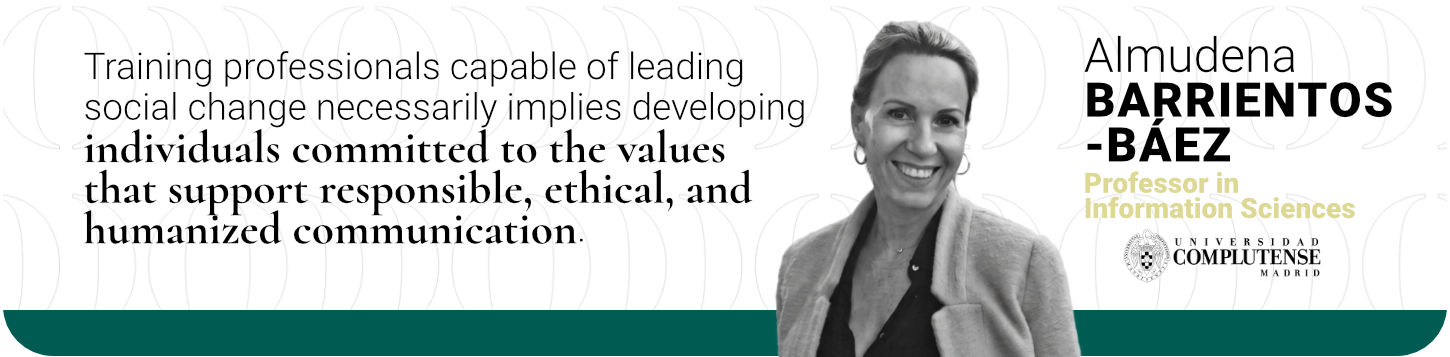
*Article written by Almudena Barrientos-Báez, lecturer at the Faculty of Information Sciences, Complutense University of Madrid, and member of the Spanish Academy of Television.