Social media, like almost everything in life, are not static. They change, they evolve, and in 2025 we will see how this dogma will undoubtedly be fulfilled. We are facing a new digital scenario with platforms, content creators and users redefining the rules of a game we thought we knew.
From the absolute dominance of the reel on Instagram, we are moving, once again, to the adoption of the traditional post (if we want to have a good reach). From a LinkedIn focused on professional achievements, we are moving to a social media, almost of a new nature, in which content and stories take precedence. There are also drastic changes in other platforms such as Twitch, the favorite (or not so much anymore) of streamers, or X, the renowned “new cradle of misinformation”.
Before analyzing these changes in depth, let’s take a look at the trends we will see reigning this 2025 in the complex and diverse social media ecosystem.
Key social media trends for 2025
Beyond the possible evolutions that each platform will undergo individually, this year we will see general changes that are shaping a new way of communicating on social media.
AI takes control of content
Artificial intelligence is revolutionizing the world of content, from better recommendation algorithms (“it looks like Instagram is spying on me!”) to automatically generated content. The future of this trend is so strong that the social media X, owned by tycoon Elon Musk, incorporates Grok as standard, its AI capable of generating content that is triumphing among the platform’s users.
Micro-influencers will have (even) more prominence
Microinfluencers and hypersegmentation go practically hand in hand: one is a consequence of the other, and vice versa. Is there a better way to approach specific and segmented communities than through opinion leaders or influencers admired by those communities? The answer is obvious: no. Brands prefer collaborations with smaller, but highly engaged communities.
The rise of user generated content (UGC)
Users and employees have become the best brand ambassadors, and brands find themselves with an almost priceless opportunity (but also with an unimaginable risk). Unboxings, hauls, tutorials… Users and content creators are incredibly imaginative when it comes to inventing new formats never seen before and with great appeal for their communities.
Audio formats resurge (amidst so much video)
Although their boom seemed to be a thing of the past, voice-over content is finding its place on platforms such as YouTube and LinkedIn. These formats are perfect to enhance personal branding, but also to reach specific audiences with storytelling and key messages.
Analysis and what to expect from social media in 2025
In view of these trends, the conclusions reached by Metricool in its Social Media Study 2025 will become clearer. This report, already considered a reference for those of us dedicated to digital communication, is a detailed x-ray of an ecosystem in constant transformation.

TikTok and YouTube: the dynamic duo of outreach
It is no coincidence that TikTok and YouTube continue to dominate the scene. TikTok, with 71% more viewing time, and YouTube, with 2.7 billion monthly active users, are the platforms where brands can achieve greater visibility without relying exclusively on paid advertising.
comma recommendation: take advantage of the short video format. TikTok and YouTube Shorts are still booming and offer a perfect space to connect with your audience in seconds.
Instagram: when posts shine again
Instagram has rewritten its own history. While the almighty reels have lost 20% of reach, the previously useless posts have grown by 21%. Carousels of up to 20 images have become the star tool for generating interaction and retention.
comma’s recommendation: don’t focus all your efforts on creating reels. Well-designed carousels can become an engagement engine, helping to keep the attention of your community.
LinkedIn: the new engagement giant
It used to be the social media for finding jobs and CVs. Today, LinkedIn is a space for valuable content. In 2024, its interactions increased by 99%, making it a fertile ground for personal and professional branding.
comma’s recommendation: bet on valuable content. Storytelling, sector-specific insights and formats such as newsletters are the most popular on the social media.
Facebook: still the king of web traffic
Despite a 41% drop in reach, Facebook remains the best platform for generating traffic. With 413 clicks per post on average, it remains key for brands with conversion-based strategies.
comma recommendation: if your goal is to drive traffic to your website, Facebook remains a key player. Combine posts with links and take advantage of the synergy with Instagram.
X (Twitter) and Twitch: uncertain times
X has had a turbulent year (and will likely continue to have a turbulent year). Despite a 50% increase in impressions, its engagement is down 30%. Meanwhile, Twitch is facing a deep crisis, with an 88% drop in subscriptions and its content creators migrating to other platforms.
comma recommendation: if your audience is on X or Twitch, diversify. Don’t put all your eggs in one basket and explore alternatives such as Threads, YouTube or TikTok.
The ideal funnel for social media
Metricool’s study suggests a strategic approach based on data, very useful to take into account in content planning and strategy creation.
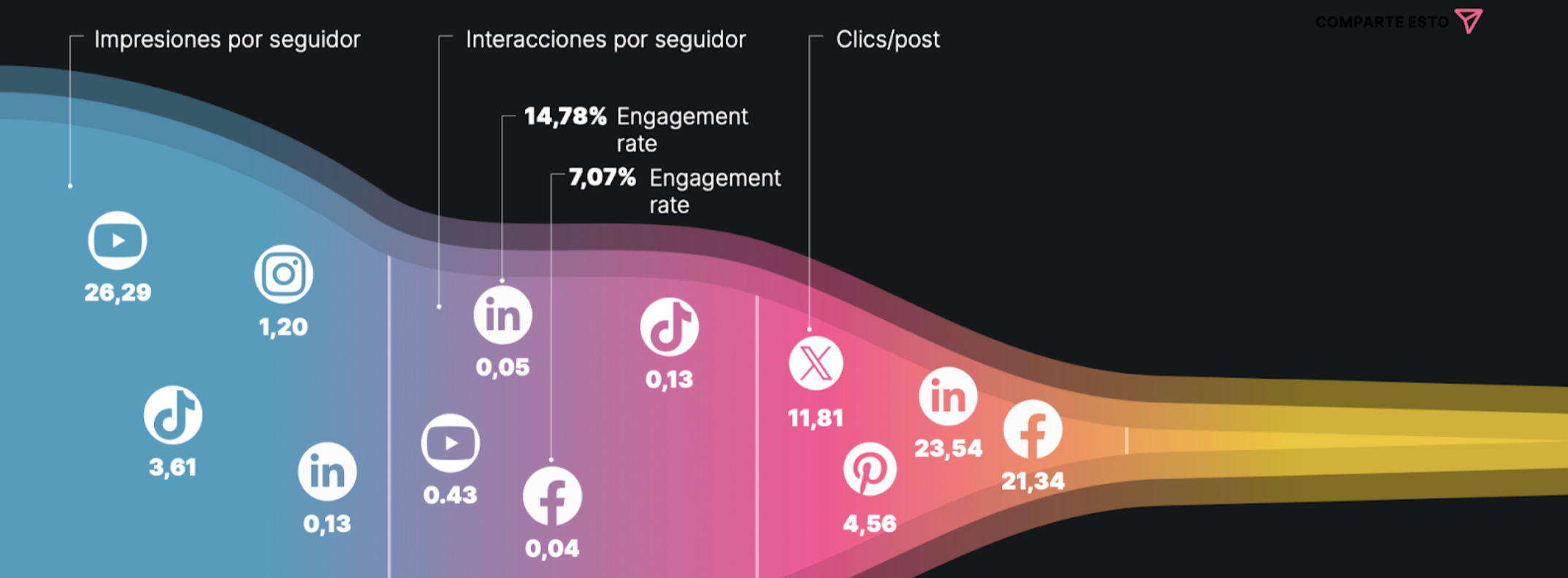
- Top of the Funnel (increase visibility): TikTok and YouTube are ideal for reaching new audiences.
- Middle of the Funnel (getting interaction): LinkedIn and YouTube generate higher engagement.
- Bottom of the Funnel (getting to conversion): Facebook and LinkedIn stand out in traffic and lead generation.
Recap
2025 presents us with an ever-changing social media landscape, where AI, micro-influencers and user-generated content will take center stage. While TikTok and YouTube dominate reach, Instagram posts are regaining their value, LinkedIn is consolidating its position as engagement leader and Facebook remains key for web traffic. X and Twitch, meanwhile, are in the doldrums, making it necessary to diversify strategies.
To succeed in this new digital ecosystem, it is crucial to adapt strategies to each platform, leveraging the power of each social media: TikTok and YouTube for visibility, LinkedIn and YouTube for interaction, and Facebook and LinkedIn for conversion. The key will be flexibility, innovation and the ability to connect with the audience through valuable content.