
It has been one year and six days since we, in this very blog, talked about the trends in digital communication that we would see throughout the year 2025. That post began with an idea as simple as it was recurrent: we people love to fantasise about what the future holds for us. Flying cars, teleportation, space travel or intelligent machines dominating the world.
Today, in 2026, that fascination with anticipating what is to come remains intact. But in digital communication, it is no longer just an exercise in curiosity; it is a strategic necessity. Platforms change, algorithms mutate, audiences fragment, and technology advances at a speed that forces us to constantly rethink what we communicate, how we do it, and, above all, for whom.
If 2024 was the year artificial intelligence finally took off, and 2025 was the year it became normalised (with ups and downs), 2026 looks set to be the year of maturity. A turning point at which digital communication will cease to be obsessed with scale and automation and refocus on something as old as it is essential: people, usefulness and trust.
These are the main trends in digital communication for 2026 that we are already beginning to detect and that will set the agenda for brands, institutions and creators of content.
Back to human: the value of what is not done with AI
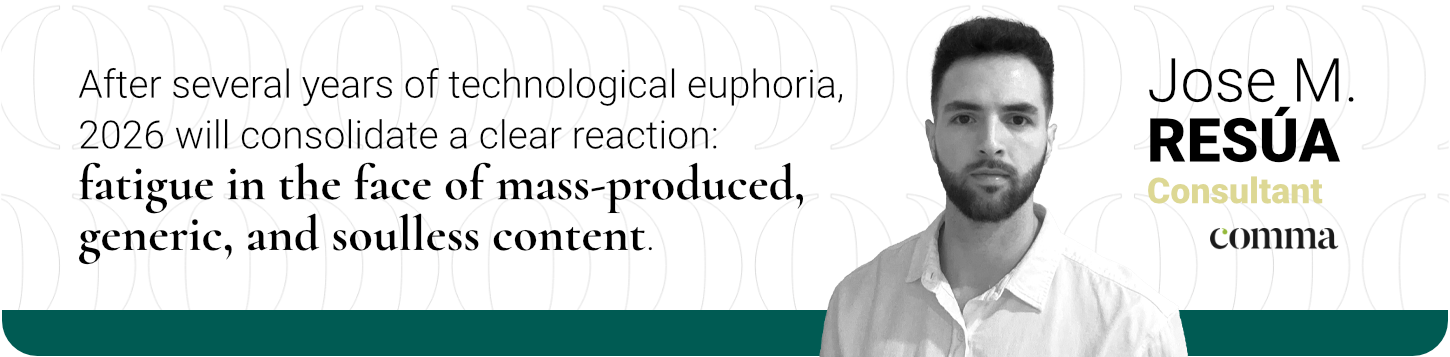
After several years of technological euphoria, 2026 will consolidate a clear reaction: fatigue in the face of mass-produced, generic, and soulless content. So-called AI slop (mass-produced texts, images and videos with no real value or criteria, or even of poor quality that demonstrate a lack of care in their production) will begin to be penalised not only by audiences, but also by the platforms themselves.
Paradoxically, artificial intelligence will continue to be a key tool, but its use will become increasingly invisible. The brands that stand out will be those capable of demonstrating human sensitivity, editorial judgement and authenticity. The imperfect, the handcrafted and the clearly human will gain relevance over the artificially perfect.
It is no coincidence that we have already seen campaigns withdrawn for abusing AI-generated resources or for failing to pass a minimum creative and ethical filter. In 2026, communication will be, more than ever, a question of intention and not just efficiency.
GEO and algorithmic reputation: communicating for AI (without forgetting about people)
Traditional SEO is not disappearing, but evolving. In 2026, brands will compete on new ground: that of GEO (Generative Engine Optimisation), i.e. optimisation for AI-based response engines.
We will witness the rise of the so-called zero-click world: searches that will no longer drive traffic to a website, but will be resolved directly in the search engine or conversational assistant itself. This will force a complete rethink of digital visibility strategies.
In this context, a concept that is still in its infancy but decisive will come into play: algorithmic reputation. What does AI say about your brand, what sources does it use, what context it offers and what biases it reproduces. In 2026, this variable will begin (hopefully) to be integrated into plans for digital and reputational crisis management.
Brands that understand how to train their digital presence for these new environments (media, experts, quotable and consistent content) will have an advantage in a scenario where it is no longer enough to position oneself, but rather to be referenced.
Politics and geopolitics: from the margins to the centre of digital content
Far from being a passing fad, politics and geopolitics are establishing themselves as key topics in digital communication and social media. The reason is simple: the global media agenda spans all areas (including economics, technology, energy, defence and digital rights), and audiences, with increasingly specialised profiles and in many cases followers of current affairs, demand context.
Clear examples are the TikTok communication strategies of institutions such as Moncloa, the Prado Museum, and political figures such as the Mayor of New York, Zohran Mamdani, who have understood that social media is not only a space for entertainment, but also for education and storytelling.
To this we can add the rise of newsletters and personal analysis formats. We can give as an example the Monthly active management, the monthly newsletter by Iván Díez, Country Head of Iberia and Latam of La Financière de l’Échiquier, on current events in markets (and many other topics), which demonstrate that there is an appetite for complex content explained in a clear and accessible manner.
In 2026, brands will not be able to ignore this context. Even those that do not explicitly discuss politics will need to understand the geopolitical framework in which they operate and how it affects their narrative.
Fewer likes, fewer comments… more real value.
One of the great frustrations of communication teams in recent years has been the gradual decline in visible engagement. In 2026, this trend will become more pronounced: there will be fewer likes and fewer comments, even on high-quality content.
The difference will be made by usefulness. Metrics such as saves or shares, viewing time, and recurrence will become much more relevant indicators than superficial interaction.
The formats that will work best are those aimed at solving specific problems or providing practical knowledge: tips, explained trends, tutorials, step-by-step guides, recipes, or applicable analyses.
Effective communication in 2026 will not be synonymous with virality, but rather with sustained relevance.
No more masses: hyper-segmentation and hyper-personalisation
This trend is not new, but in 2026 it reaches full maturity. Mass communication ceases to make sense in an ecosystem where there is no longer a homogeneous audience. There is no mass; there are communities, niches and micro-interests.
Hyper-segmentation of audiences and hyper-personalisation of messages (two terms we were already using in 2025) become a strategic requirement. It is not just a question of adapting the channel, but also the language, approach, timing and value provided to each audience.
Communication becomes surgical. Fewer impacts, but better targeted. Less noise and more connection. The goal is no longer reach, but rather building solid, lasting bonds.
Deepfakes and fake news: a structural threat
Unfortunately, another trend that will become more prevalent in 2026 is the increase in deepfakes and fake news. Technology is advancing faster than regulation and digital literacy, creating a perfect breeding ground for misinformation.
Recent cases, such as certain media crises linked to generative AI tools (the most notorious being Grok), highlight the fragility of the current information ecosystem. And everything points to us seeing more similar episodes throughout the year.
For brands, this means taking on a new reputational risk. Monitoring, verification and responsiveness are no longer optional. Digital communication in 2026 will need to incorporate clear protocols for dealing with content manipulation and identity theft.
Conclusion: communicate less, but better
Digital communication trends for 2026 paint a demanding picture, but also one of a new world full of opportunities. This will be the year when technology ceases to be the focus of discussion and becomes a tool at the service of judgement and strategy but, above all, of trust.
In a way, we are returning to the fundamentals: understanding who we are talking to, providing real value, and protecting our reputation. We must accept the responsibility that comes with communicating in a hyperconnected environment.
In a world saturated with messages, winning will not be shouting louder, but saying something that really deserves to be heard.