
For years, companies have competed on the basis of their ability to do. Doing more, doing better, doing faster. The advantage lay in the execution: in how things were produced, in how the processes were optimised, in how the business was scaled without losing efficiency… If we want to be realistic, it looks like this framework is running out.
The emergence of artificial intelligence brings new tools, but, at the same time, it highlights the fact that the ability to do ceases to be distinctive because, for the first time, it is accessible to everyone. Automate, scale, optimise, produce content, make decisions with assistance… all of that is already ceasing to be a competitive advantage in its own right, to become a commodity.
If we’re all going to be able to do everything, the difference won’t lie in the actual doing. This is where the nature of the business will start to change.
When execution no longer depends on people, when knowledge is accumulated in systems that learn from every interaction much more quickly, and when decisions are integrated into automated workflows, the organisation begins to resemble less a collection of teams and more an operating system. A system that functions, learns and acts continuously.
But who ensures that all of this meets a clearly defined set of criteria for business purposes?
For a long time, that approach was implicit within organisations. It was passed on through the culture, in conversations, and through people’s accumulated experience. It was imperfect, sometimes contradictory, deeply human… but, above all, very difficult to scale without it becoming distorted.
No one doubts that AI is set to overcome this limitation, as it enables decisions, knowledge and operations to be scaled with a consistency never seen before. But in doing so, it also removes an element which, although it caused complications, forced us to think, to stay connected, and to act as a whole.
Coherence as a structural element
This is where the risk lies. And it is not the risk of doing it wrong. The new risk is more subtle: doing everything right and, even so, not meaning anything.
Perfectly optimised companies, capable of responding in real time, adapting to their circumstances and producing without limit… yet indistinguishable from one another. Because the system has optimised everything that can be measured, but not necessarily what cannot.
In this context, consistency ceases to be merely a desirable attribute and becomes a structural element. It ceases to be a rigid rule, a style guide or a matter of aesthetic consistency, and instead establishes itself as an organisation’s ability to act in a way that is consistent with what it claims to be.
When an organisation operates according to clear principles, it can automate its processes without losing its identity. Optimisation then ceases to be an end in itself and becomes a natural consequence. It is not something that should happen by default.This remains the organisation’s responsibility. And, more specifically, the responsibility of someone within it.
This is where the evolution of communication takes on a different meaning. Over the years, the role of the communications director has shifted from a function focused on the message to a broader role that is fully integrated into corporate affairs. It has moved from explaining decisions to helping shape them, from managing reputation to interpreting context, and from simply issuing statements to ensuring alignment.
That shift was no accident. It was a response to a growing need for consistency in increasingly complex environments. But AI takes that need to a whole new level.
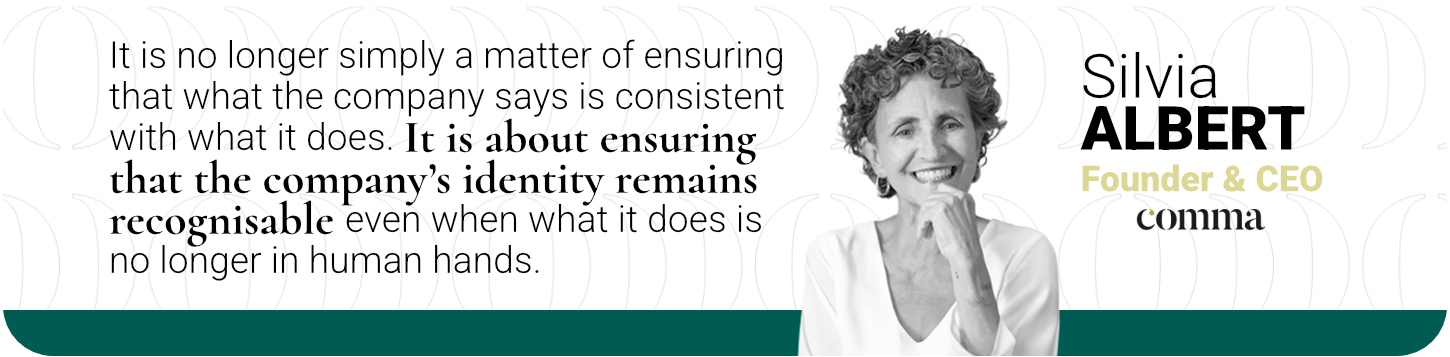
It is no longer simply a matter of ensuring that what the company says is consistent with what it does. It is about ensuring that what the company is remains recognisable even when what it does is no longer in human hands.
Identity, criteria and action
We must accept that consistency is not merely a matter of communication nor of reputation, but rather that it forms part of the organisational architecture: of the design of the systems, of the criteria that governs them, of what boundaries are set and which decisions are automated.
That space, which is still somewhat vague, is beginning to call for a new responsibility. Not necessarily a formal role, but a function that someone will have to take on.
Some are starting to refer to it as the Chief Guidance Officer (CGO). Not so much as a new title on the organisational chart, but as a way of describing something that is not yet clearly defined: the need to link identity, judgement and action in increasingly automated systems.
It is not a technical function. Nor is it purely strategic. And it is certainly not operational. It is, in essence, a governance function. Governance not in the hierarchical sense, but in the sense of providing direction. It is about ensuring that the organisation, as a whole, does not lose sight of what defines it whilst gaining the capacity to do practically anything.
This does not mean concentrating decision-making in the hands of a single person. That would run counter to the very logic of distributed systems and collective intelligence. In reality, decision-making is a shared process. It is the result of a culture, of accumulated decisions, and of a way of being in the world. But it needs to be safeguarded and structured.
A new leadership
And that is where true leadership comes into play: leadership that reflects the collective will and makes decisions—without imposing or controlling—based on what has been agreed upon, because it understands that consistency is synonymous with commitment.
I don’t think there’s any doubt that the difference won’t lie in the integration of systems that automate, learn and operate on a scale that’s impossible for humans. The key now is what we’re going to do with that capability, how we’re going to direct it, what we’re going to retain because we consider it essential, and what we’re no longer going to rely on from now on.
The organisation will begin to operate on a different level by ceasing to do things that no longer add value, precisely because AI does them better. That is the transformation. What the organisation stands for takes precedence over how it operates, which is why consistency emerges as the only way to project a clearly recognisable identity in an environment where everything else tends to look the same.
Ultimately, AI is forcing companies to be clearer about their own identity and to consciously embrace what they stand for. From now on, it will no longer be just a question of efficiency.
And that inevitably redefines the basis on which everything else is governed.