
Some campaigns fail because they fail to find the right message. Some campaigns succeed because they get the tone, the timing and the right approach just right. And then there are campaigns that fail for a reason that is harder to pinpoint: what they choose not to say.
At comma, we are convinced that communicating is power. The power to construct narratives, to raise awareness, to preserve memory and to decide who takes centre stage in a public conversation.
The latest campaign by Madrid City Council to mark Pride 2026 is based on a slogan that appears to be friendly. “Diversity is lived in Madrid”. It sounds positive, inclusive and easy to accept. Perhaps that’s why it’s worth looking at it with a bit more attention. Who experiences that diversity. Who represents it. Who appears in the story.
Because on the posters we don’t see any LGTBIQ+ people from Madrid. We see balconies, flowers, shops, terraces, colours and scenes from everyday life in the city. We see Madrid. But we don’t see those who have made Pride a collective achievement, a public presence and a shared memory.
This shift and this absence are no small matter. The campaign positions Madrid as the centrepiece of Pride, whilst LGBTIQ+ people are reduced to an implicit presence, suggested merely through the colours of the rainbow flag. The result is a visually appealing but politically incomplete message.
In communication, these omissions also convey a message.
When absence also conveys a message
Pride did not begin as a friendly celebration of diversity in cities. It began as a response to persecution, silence and invisibility. It began as a way of claiming public space at a time when many people were being excluded from it. It began to give a name, a face and a voice to those who had been forced to live on the margins.
That is why promoting Pride requires more than simply using that rainbow colour scheme, which has been so overused and trivialised by the mass media. It requires an understanding of what it stands for. We are not just talking about an inclusive campaign or a positive image for the city. We are talking about a collective memory built on a spirit of advocacy.
The slogan “Diversity is lived in Madrid” can be seen as an invitation to normalise diversity in everyday life. And that idea is valuable. Diversity should not exist for just one week, nor should it be confined to high-profile moments. It should be part of everyday life, of neighbourhoods, of homes, of workplaces and of shared spaces.
The problem arises when that standardisation is communicated without subjects. When diversity becomes part of the urban atmosphere, but not in human presence. When we talk about a diverse city, but not of the diverse people who live there.
Madrid is no minor player in this story. Its Pride is one of the major international events, one of the most well-attended gatherings in Europe and a space where celebration, activism, tourism, culture, the economy and rights coexist. Precisely for this reason, institutional communication surrounding Pride carries a greater responsibility than perhaps any other. It cannot be treated merely as a city asset or a tourism brand. Nor can it be seen simply as a pretty postcard depicting Madrid’s spirit of togetherness.
Pride is a celebration, yes. But it’s not just that. It is also remembrance, protest, reparation and presence.
When Madrid takes up the whole frame
Every institutional campaign chooses a central figure. In this case, the spotlight seems to be solely on… Madrid. Its balconies, its terraces, its shops, its colours. Its sense of community. Diversity emerges as a defining feature of the city, almost like a brand attribute. Madrid is open. Madrid is welcoming. Madrid is diverse.
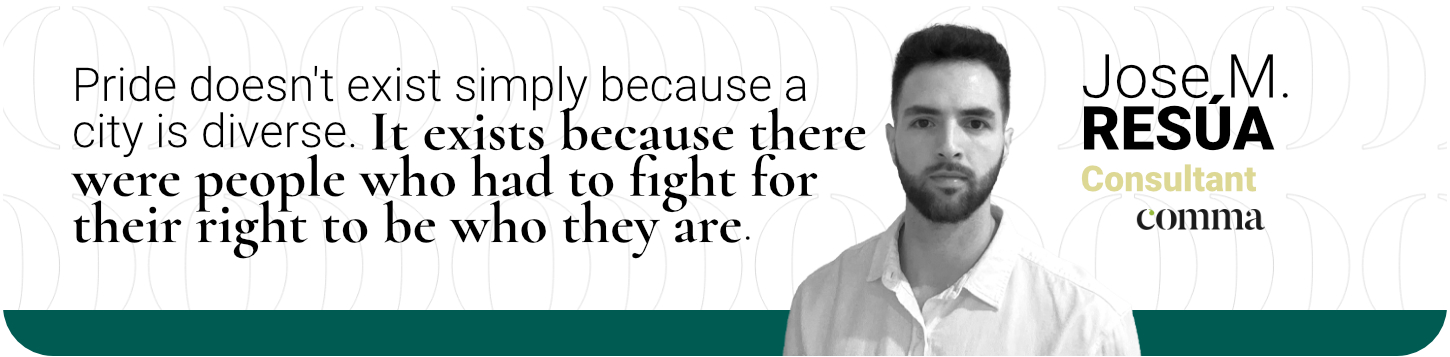
None of that need be problematic in itself. The tricky part is that, by placing the city at the centre, the campaign runs the risk of appropriating a history that did not originate in institutions, but on the streets. Pride does not exist simply because a city is diverse. It exists because there were people who had to publicly assert their right to be so.
Therein lies one of the most interesting tensions in the field of communication. An institution can celebrate diversity, but it must do so without marginalising those who brought it to light. It can champion an open city, but it should not reduce the LGBTIQ+ community to a mere backdrop. It can talk about coexistence, but without erasing the conflict that made that coexistence necessary.
The campaign aims to convey that diversity is part of everyday life in Madrid. But by avoiding faces, bodies, names or explicit references to the community, it leaves a question unanswered. Are we talking about diversity, or are we using diversity as a way of talking about Madrid?
When the representation is not an ornament
In corporate communication and institutional communication, we talk a great deal about representation. Sometimes it seems like an overused term. But cases like this remind us why it still matters.
To represent does not mean to place symbols in a generic manner. To represent is to decide who appears, who speaks, who occupies the centre of the story and who is left in the background. In a campaign on LGTBIQ+ diversity, the absence of people from the community is not a neutral decision. It can be interpreted as a way of universalising the message, but also as a way of neutralising its political agenda.
Institutions need to address a wide audience. They must craft inclusive messages. They must ensure that public communication does not become a source of exclusion. But inclusivity must not mean blurring the lines. And toning down a message should not mean stripping it of its history.
When a Pride campaign replaces people with objects, it runs the risk of shifting the focus from rights to decoration. From memory to aesthetics. From advocacy to a postcard.
When we run the risk of turning diversity into a mere backdrop
One of the major challenges facing communication today is to prevent social causes from becoming empty visual codes. This happens with sustainability, equality, diversity and in any area where symbols carry reputational value.
The rainbow, like any symbol that is powerful, can mean many things. It can be a flag of struggle, a gesture of support, a symbol of belonging or a visual device. The difference lies in the context, the intention and the consistency.
In this campaign, the colours are there. So is the urban setting. But the community seems to be diluted into an abstract idea of the city. Diversity is presented as something that Madrid embodies, rather than as something that LGBTIQ+ people have championed, fought for and upheld for decades.
Communication does not just shape our image. It also shapes our memory. It determines what we remember, how we remember it, and whom we recognise as the protagonist of a story.
When we realise that memory also communicates
At a time when many social achievements seem to be firmly established, there is a risk of presenting rights as though they had come about of their own accord. As though equality were a natural evolution of societies rather than the result of decades of mobilisation, organisation and conflict.
But rights are not merely institutional window dressing. They are hard-won achievements. And every achievement has names, bodies, voices and memories.
Pride came about precisely so that LGBTIQ+ people would not be silenced or rendered invisible. That is why any campaign that aims to represent it should ask itself a simple question. Is it raising awareness, or is it replacing that awareness with a feel-good metaphor? Is it commemorating the struggle, or merely celebrating its outcome? Is it talking about diversity, or is it avoiding any mention of those who made it possible? Memory does not preserve itself. It is shared. And when it is not shared, it weakens.
When we can celebrate without holding back
Institutions find themselves in a complex (and sometimes even delicate) position when faced with movements that arise from social demands. When they incorporate these movements into their communications, they can help to normalise rights, broaden support and project an image of a more open city. But they may also be tempted to neutralise the conflict in order to make it more palatable, more aesthetically pleasing or easier to share.
The challenge lies in striking a balance between celebration and advocacy. Between a sense of belonging and remembrance. Between pride in the city and pride in the community.
Madrid can celebrate the fact that diversity is part of its everyday life. It must do so. But that idea gains strength when it acknowledges those who made it possible for that diversity to be experienced freely. Without that acknowledgement, the campaign remains a correct but incomplete statement.
Communicating Pride isn’t just about saying that Madrid is diverse. It’s about explaining why it can be so – and thanks to whom.
When we learn to recognise who not to delete
Every institutional campaign makes choices. It chooses images, words, symbols, approaches and what it leaves unsaid. Much of its credibility hinges on those choices.
The controversy surrounding the 2026 Pride campaign should not be limited to whether people like the posters or not. What happens when a public message tries to be so universal that it loses its connection to its origins? What happens when a cause becomes merely a matter of aesthetics? What happens when a city takes centre stage in a story that was created to raise the profile of a community?
Pride does not need to be expressed in a strident manner to be a statement of defiance. But neither can it be expressed with absolute neutrality without losing some of its meaning.
In communication, it is not enough simply to be on the right side of the values. You have to know how to represent them well. And representing them well involves something as simple and yet as difficult as not erasing those who gave meaning to that narrative.
Madrid City Council should learn a lesson from this campaign. After all, Pride wasn’t created to decorate the city. It was created to take it over.