
Who would have thought, when I started working as a graphic designer at comma agency almost a decade ago, that I’d have to keep such a close eye on the latest developments in design as my colleagues in communications do on financial news.
Of course, the desire to keep up to date with the latest trends and to follow developments in the tools and processes that can optimise them is an integral part of being a designer. In the past, this involved watching Adobe tutorials (Photoshop, Illustrator and InDesign) and keeping up with the steady stream of updates that improved workflows and made it easier to create new styles.
But the current whirlwind of change, with a new revolution in graphic design tools emerging every week, is overwhelming.
We’ve already discussed previously how Adobe’s dominance has been shaken by the emergence of free competitors such as Affinity Studio, which are backed by Canva with its artificial intelligence – which is precisely where they’re trying to monetise this project. The latest giant leap that left us speechless came when they unveiled Magic Layers. Finally, we can edit images generated by any AI using layers. Gone are the days of having to fiddle with prompts for every minor change, such as a colour or a font type.
Over the summer, Google Pics – which was announced at the last I/O – will be launched, promising image generation with advanced controls to move, resize and transform objects, edit or translate text, or retouch specific areas of your images. And all of this is integrated into its workspace. Google is doing everything it can to ensure you never have to leave its ecosystem at all. This is an approach also pioneered by the Spanish company Magnific (formerly known as Freepik) with an infinite visual canvas system where you connect different AI cards to design, automate and control the entire creative process in a single workflow.
Gemini Omni will also be wowing us very soon with its video generation capabilities. Google is well aware of the potential held by many content creators who do not make the leap to video due to a lack of technical resources (cameras, lighting, locations, make-up, etc.). Its commitment to digital avatars is clear. Think of that client who has a wealth of knowledge on a subject but doesn’t perform well in front of the camera. Omni will allow us, starting with a photo and some text, to generate a video in which our client—perfectly lit and looking their best—explains to us, looking straight at the camera with impeccable diction and without hesitation, the advantages of active management or blockchain decentralisation. Rumour has it that it will be integrated into YouTube Shorts. This would put the current market leader, HeyGen, under pressure.
Another contender is making its mark. Claude Design is a game-changer because it significantly lowers the technical barriers to app and web design. Unlike traditional visual generators, which only create static images, Claude Design creates functional interfaces and mock-ups (in live code such as HTML/JS) that you can click on, interact with and test in real time within its canvas. This is a huge help for developers, who can optimise their workflows by creating elements with a simple prompt.
Now, with the Vibe Coding boom in full swing – which has made coding accessible to everyone – there is a wide range of new web apps available for applying image styles or creating simple motion graphics.
Our favourites web apps for design
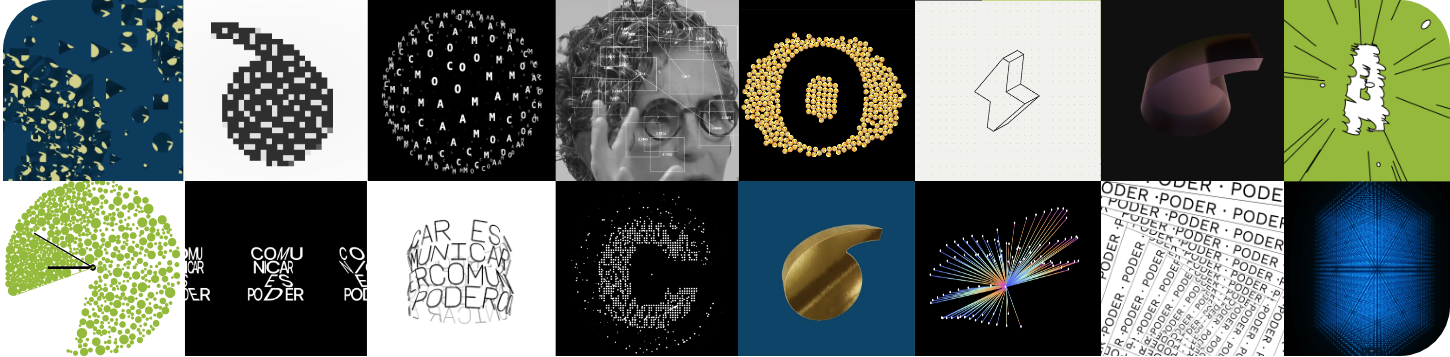
If I had to draw up a list of my favourite web design apps, they would undoubtedly be these:
Dithering effects on images. A variation on pixel art to achieve an alternative, nostalgic or cyberpunk aesthetic.
Library of resources for isometric icons with an interactive panel to change the perspective, adjust the style and choose the colour.
Interactive visual effects of elastic text, distorted, moving or with circular shapes. Three-dimensional graphics and mathematical simulations rendered in real time (such as Voronoi fractals or liquid metabolas).
Transform any object (using your webcam or by uploading a video file) into a motion in trails that are fluid, dynamic and abstract.
Developed by Wix, it allows you to create, customise and export visual effects, kinetic typography and reusable 3D scenes without needing to know how to code.
Designed to instantly transform any flat 2D logo into an eye-catching three-dimensional version. It also allows you to create videos with 360-degree rotations and adjust the axis of rotation.
A fantastic collection of custom typographic animations. Although the ability to edit all elements (text, shape, colour, animation, etc.) depends on the individual template, you’ll be amazed at what you can achieve with this system, which even works on your mobile.
A WebGL-based experimentation environment designed for the interactive simulation of 3D particle swarms. It converts prompts into JavaScript code, allowing you to control the behaviour of over 20,000 particles.
A tool for tracking moving objects (blob tracking) that applies interactive visual effects (heat maps, glitch-style distortions, particles and dynamic text labels) to your video file.
Anatolii Babii presents his portfolio featuring projects in the field of animation of abstract elements which the user can edit according to their needs and export in various formats.
This interactive experiment in design and movement, centred on three-dimensional typography, invites users to play freely and explore how letters sculpted from voxel-style blocks (3D pixels) behave and interact.
An online interactive design multi-tool that allows you to create custom typography, effects and 3D objects without writing any code. Dozens of templates featuring material effects, extrusion, textures and distortions that can be edited in just a few clicks.
More than 110 animated and interactive components (with smooth micro-interactions, scroll effects and visual transitions) exportable as code snippets ready to copy and paste.
Tools to suit every taste
It is clear that, now more than ever, we have countless ways to bring out our inner artist. Will the dizzying pace at which new graphic tools are appearing continue to amaze us next week, or will it eventually bore us? Technology now allows users without extensive graphic design skills to bring their ideas to life with ease, but the democratisation of these processes carries the risk of visual homogeneity.
Think back a few months to the first time you saw that picture on Instagram of your mate turned into an action figure, or your girlfriend drawn in Pixar style. Amazing, isn’t it? But when you’ve seen it ten times over – even on your sister-in-law’s profile – it gets a bit tiresome, doesn’t it? Some media outlets overuse these eye-catching effects, without realising how quickly they go out of fashion.
This is why strategic design is so important. We must make the most of the new opportunities that technology offers us, whilst carefully assessing their impact and how they evolve.
It is discernment that will make the difference. As Víctor Palau says in Gráffica: “Now that everyone can design, it matters more than ever.” But it is not just that; experience, knowledge and craftsmanship will also set us apart.