A few days ago, while listening to the presentation of SEC Newgate’s Impact Monitor 2025, a thought struck me: it is fascinating how we use acronyms that sound like they belong in an advanced intelligence department, when in reality we are simply trying to explain that a company should basically be a good neighbour. I am referring to ESG (Environmental, Social, and Governance), a concept that 63% of Spaniards admit to knowing nothing about.
The term ESG has become popular since 2004, when the report ‘Who Cares Wins’ was published, a joint initiative by financial institutions led by the then UN Secretary-General, Kofi Annan, to find ways to integrate environmental, social and governance factors into the capital market. And since then, while communication agencies, companies and organisations have been striving to adjust the tone of sustainability reports, six out of ten people on the street think we are talking to them in Morse code or, worse still, that we are simply filling space.
One quickly learns that the longest distance in the world is not between Madrid and New York, but between a management committee and a shopping trolley in a local supermarket. Only 13% of citizens say they really understand what these acronyms mean. As Ana Gascón, Director of Human Resources, ASG, and Shareholders Office at PremiumFiber, pointed out in the presentation of the report: “It’s being seen, but it’s not getting through”. Companies are putting huge budgets on the table to transform themselves, but that investment seems to evaporate before it crosses the office door.
The Arctic is far away, but my postcode isn’t: there’s a trend that makes me smile because of its overwhelming logic: relocation. We’ve spent decades worshipping globalisation as if it were an infallible deity, only to realise that its impact is no longer measured globally, but locally. The report makes it clear: “Local is the new Global”. For me to believe that your brand is going to save the glaciers, I first need to see what you are doing for the park on my street.
72% of Spaniards prefer companies to manufacture here, at home, even if that means the final bill goes up. We want them to hire here (68% support) and buy raw materials from domestic suppliers (67%). It’s a kind of local activism. Beatriz Herrera, Corporate Communication Strategy, Reputation & Sustainability Director at Mahou San Miguel, summed it up with a phrase that should be on every marketing director’s screensaver: “Bring it down to me and tell me how this impacts my day-to-day life.” If sustainability can’t be touched, or at least seen in the neighbourhood, for many it simply doesn’t exist.
The wallet: that place where activism takes a break. Here comes our great contradiction, the one that makes us human and a little inconsistent. We love the idea of ethical business until we look at our bank account. Fifty-one per cent of Spaniards believe that tariffs should be reduced to encourage competition and lower prices. We want production to be domestic, but we also want avocados and mobile phones to continue to cost the same as when they came from the other side of the world.
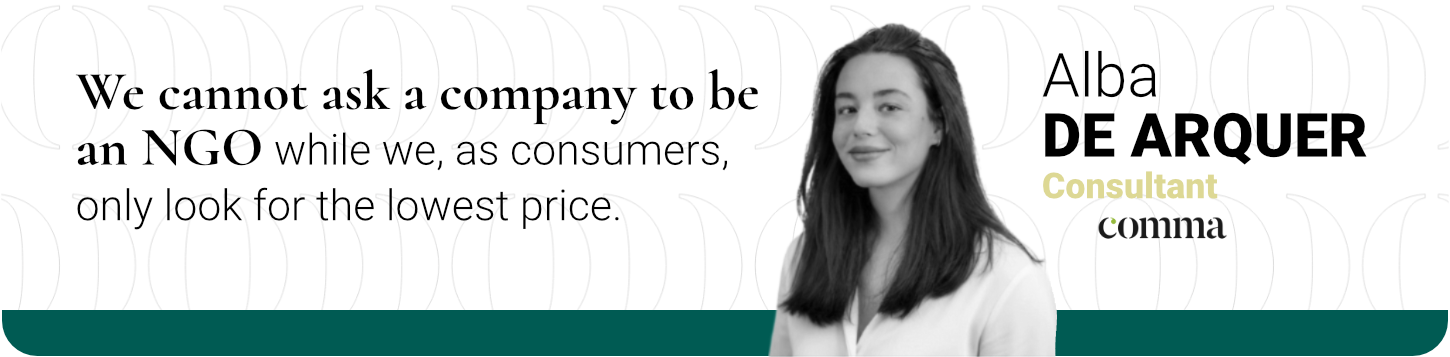
This is what Beatriz Herrera calls shared responsibility. We cannot ask a company to be an NGO while we, as consumers, only look for the lowest price. With inflation pushing up the cost of the shopping basket by 35%, activism has become, for many, a luxury item they cannot afford. In fact, 56% of the population believes that companies should prioritise raising wages over reducing carbon emissions. In the end, it turns out that the first layer of sustainability is making ends meet.
The bureaucracy of ‘excellence’ and the virus of mistrust
There is a critical, almost scathing view of how this is managed internally. Sometimes it seems that we care more about the exam than the subject itself. Ana Gascón spoke of the difference between students who are only looking for a pass mark and those who really want to learn. The role of sustainability has become so bureaucratised that we run the risk of spending more time filling in indicator tables than transforming the business model.
And citizens notice this. Mistrust is the general mood: only 29% of people believe that large companies are transparent. This is the lowest score in the entire report. If we are not open, if we do not communicate naturally, people assume that we are hiding something under a mountain of technical terms. As Ana says, “a cat is a cat”; we can call it ESG, impact or transformation, but if there is no consistency underneath, the consumer simply tunes out.
What keeps us awake at night (and it’s not a 40-pages PDF)
Sometimes, in the bubble of the business world, we forget what the real priorities of people are. The report is a reality check: quality and accessible healthcare (65% of utmost importance), housing affordability (62%) and education (62%). These are the pillars upon which 78% of the Spanish builds their demand: they want companies that act in the interests of everyone, not just of the shareholders.
We value diversity. 72% strongly support closing the gender pay gap. We care about the planet, of course: 74% believe it is vital to take action against climate change. But all this has to be connected to real life. We don’t need more classroom teaching, but brands that understand that their survival depends on being relevant to their neighbours, not just their investors.
After delving into this data, my conclusion is that sustainability must, above all, be affordable and understandable. Being an activist by shopping consciously is all well and good, but the Impact Monitor reminds us that, in the current context, it is a privilege that not everyone can exercise.
If companies want young people (and those who are not so young) to trust them again, the answer is not to invent another acronym in English. The way forward is to demonstrate impact in small, everyday ways, in what Beatriz Herrera defines as the “fundamental simplicity of facts”. Less global rhetoric and more local commitment. Because, at the end of the day, if your company doesn’t improve my neighbourhood, I’m hardly going to believe that you’re going to improve the world.