
The Men’s World Cup kicks off tomorrow. For a few weeks, all the major societal problems seem to be put on hold: millions of armchair pundits will spring into action, sitting comfortably on their sofas or at the pub, knowing exactly what should have been done on that missed golden opportunity. In short, the tears of joy and sadness that only sport is capable of bringing about will return.
As they say: this time it’s different. Because this is the first time Spain has started as the clear favourite since that South African summer of ‘the Iniesta of my life’, ‘Waka Waka’ and Paul the octopus trying to predict the outcome of every match. The world, meanwhile, has changed at a pace that is very difficult to keep up with. Today we no longer rely on a cephalopod to make predictions, but instead turn to artificial intelligence models capable of processing vast amounts of data and variables.
But, even though it may seem as though a hundred years have passed, there is one thing that remains just as relevant today as it was then: the importance of auctoritas. We are not talking about leadership in the conventional sense, but about something much deeper: the ability to provide a point of reference, to bring order, to interpret events and to inspire confidence in times of uncertainty or collective weariness.
In fact, in today’s digitalised world, auctoritas has become even more essential. We have seen this in very recent cases in the world of football, as we noted last week in this very column when analysing the famous press conference held at Real Madrid’s headquarters by Florentino Pérez, now the triumphant winner. And this is a concept that goes beyond sport. Because it seems that something similar is also happening in today’s news landscape. Access to information has never been so easy, with so many sources, channels and tools. However, this is not helping to bring greater clarity of thought; on the contrary, it leads to a saturation that makes it difficult to distinguish between signal and noise.
The space for context in the age of TikTok
Behind this reality lies the sense that, in certain complex fields, it is becoming increasingly difficult to find platforms capable of providing context and depth on a consistent basis.
It is not a problem of a lack of information. Quite the opposite. News, analysis, opinions and data now circulate at such a speed and in such a volume that it becomes impossible to process. Added to this is a social and technological ecosystem that rewards the immediate, the emotional and the simplified. Many information-gathering habits have changed radically in just a few years. Younger colleagues readily admit that they ‘keep up to date’ via Instagram, TikTok or snippets distributed algorithmically across various platforms.
Such are the times we live in. Platforms respond effectively to an ever-faster pace of consumption. But what about issues that require more time? Stripping away the nuances has consequences. This is particularly true in fields such as economics or finance, where decisions have a very tangible impact.
The temptation to let AI call the shots
The rise of artificial intelligence adds a new layer of complexity. Tools such as ChatGPT, Gemini and Perplexity no longer function merely as sophisticated search engines. Increasingly, users are turning to them to obtain summarised answers, compare options, understand industries, or form an initial impression of companies, markets or trends.
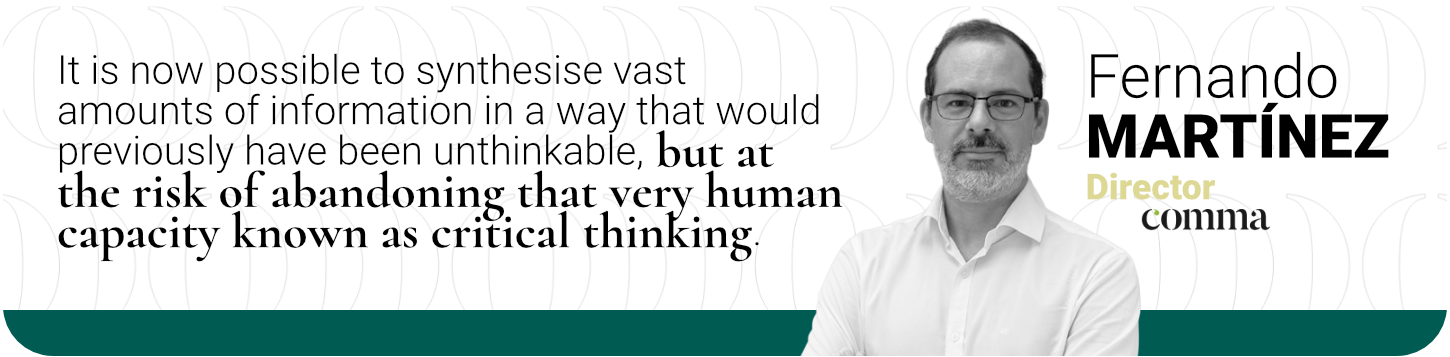
Using AI as a first line of defence has obvious advantages. Access to knowledge is simplified. It is possible to process and synthesise vast amounts of information in a way that would previously have been unthinkable, but with the risk of, almost without realising it, abandoning that very human capacity known as critical thinking. And that makes the quality of the sources feeding the ecosystem particularly important.
In this situation, the gradual disappearance of certain specialist outlets – or the difficulty in sustaining journalistic models based on in-depth reporting and expertise – also affects the quality of public discourse and, ultimately, our collective ability to interpret phenomena, whether complex or straightforward.
A responsibility that influences decision-making
Financial literacy is a good example. Spain has historically suffered from significant shortcomings in this area, and the current situation probably makes it more necessary than ever for the public to be able to understand basic economic concepts, assess risks and identify reliable information when making decisions. This is not only a matter of individual responsibility, but also because many of the major contemporary challenges – from geopolitics to the technological or energy transition – have an economic dimension that is difficult to ignore.
However, the media landscape often pushes in the opposite direction: towards an immediate and emotional reaction.
Perhaps that is why it is significant that, while the World Cup is once again dominating conversations and screens, Spain has also recently been visited by Pope Leo XIV. Regardless of one’s religious beliefs, few global figures today so clearly embody a form of authority that is difficult to establish in the contemporary world: an authority based less on bombast or speed than on the ability to maintain a recognisable voice. It is no coincidence that a large part of his recent remarks have centred precisely on issues such as artificial intelligence, human dignity, or the need to preserve spaces for critical thinking in the face of increasingly automated processes.
In an environment of scattered attention and fast-paced narratives, auctoritas is not so much about imposing a voice as it is about remaining a consistent point of reference that does not vanish with a single click.
Credibility is the strategic asset
Communication plays a major role in all of this. For years, many organisations competed primarily for visibility. Today, that seems insufficient. As information multiplies relentlessly, the real difference lies less in taking up space and more in providing clarity and context.
Reputation no longer depends solely on being present, but on becoming a point of reference that is truly useful. Perhaps therein lies an important part of the challenge for contemporary for media, businesses and institutions. Not in speaking louder and louder. But rather in helping to preserve our ‘magnificent humanity’. In the face of the chaos, auctoritas.