
For decades, the Public Affairs have been the main tool for companies to manage their relationship with the political and institutional environment. This model worked in a context that was stable and predictable. At that time, the work was based primarily on monitoring legislation and direct dialogue with the public decision-makers. It was a role that was essentially reactive to specific regulatory initiatives. Today, however, that traditional approach has begun to reveal obvious limitations and is no longer sufficient to protect the interests of an organisation.
The environment in which companies operate has changed in a profound and rapid manner. Regulatory pressure has intensified significantly in the last few years. Political cycles have been accelerated and the centres of power are found today more fragmented than ever. To this we must add some social expectations regarding the behaviour corporate which are becoming increasingly more demanding and critical. In this new scenario, there arises a need to evolve towards the Corporate Affairs.
A structural change, not a fad
It is essential to make it clear from the outset that the role of Corporate Affairs is not merely a passing organisational trend. Nor is this simply a change in terminology for what we have always done. This is not a break with the past, but rather a natural evolution of the role played by the communications director. It is a structural adjustment that enables companies to manage their relationship with an increasingly complex political, regulatory and social environment.
The main limitation of the model of traditional public affairs has not been its lack of professionalism, but rather its biased approach. For too long, this role operated in a manner relatively isolated within the company. It focused on the relationship with the administration and the legislature, but remained disconnected from other critical dimensions. I am talking about areas such as reputation, sustainability or corporate purpose, which were previously managed in independent silos. Corporate Affairs is breaking down those compartmentalised silos to provide a vision of the whole.
The new framework for public decision-making
Nowadays, public decisions are no longer made solely in the chambers of parliaments or within government departments. Today, these decisions are also shaped by social debate and public opinion. They take shape in the media, in the courts, within NGOs and in the markets. Furthermore, they unfold in digital environments that are often highly polarised. Regulation no longer comes about in isolation, but is shaped under constant public and reputational scrutiny.
Advocating a regulatory stance without social legitimacy is becoming increasingly ineffective. Reputational consistency has become an essential prerequisite for any institutional action. For all these reasons, Public Affairs alone fall short in their ability to respond effectively. The discipline of Corporate Affairs brings together under a single strategic framework various areas that have previously been fragmented. We are talking about a genuine connection between communication, public affairs, reputation, sustainability and regulation.
An intelligence system for senior management
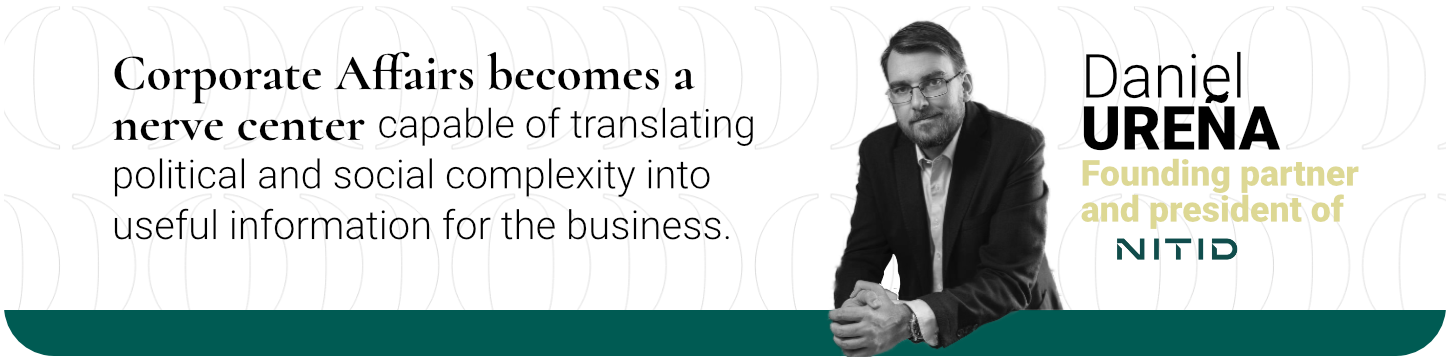
The key difference with this model is that it is not limited to managing institutional relationships. Corporate Affairs acts as a genuine intelligence and foresight system at the service of senior management. It becomes a nerve centre capable of translating political and social complexity into useful business intelligence. In many companies, this integration already exists in practice, even if it is not always formally reflected in the organisational chart.
The market has not yet standardised its terminology, but the direction of change is clear. One of the major qualitative leaps forward compared to the traditional model is the shift from reaction to anticipation. In an environment characterised by political volatility and regulatory uncertainty, the ability to anticipate has become a key competitive advantage. The most forward-thinking companies analyse trends and develop future scenarios long before a regulation is even proposed.
Risks geopolitical and competitiveness
Leading organisations today view politics as an integral part of the business environment. It is no longer seen as an occasional external threat, but as a constant management factor. This approach of strategic foresight not only reduces risks, but also enables better decision-making. Furthermore, it strengthens the company’s institutional legitimacy in the long term. Corporate Affairs thus acts as a radar that identifies weak signals within the regulatory ecosystem.
There are global geopolitical risks that have a direct impact on economic activity. Disruptions to global trade and fiscal fragmentation are challenges that no management team can afford to ignore. Added to this are technological competition surrounding artificial intelligence and the vulnerability of supply chains. Even demographic and cultural pressures on talent are now a risk that must be managed through this cross-functional role. Ignoring these variables means operating blindly in a global market.
Direct access to the CEO and corporate governance
This transformation has resulted in a profound organisational restructuring. The strategic importance of the function is reflected in its reporting line within companies. According to recent data, 84% of Corporate Affairs executives now report directly to the CEO or the executive committee. This indicates that the management of intangible assets can no longer be disconnected from strategic business decision-making.
There are different implementation models depending on the maturity of each organisation. The integrated model brings together communications, public affairs and sustainability under a single leadership. Others opt for a coordinated model, where the areas retain separate leadership but work through systematic collaboration mechanisms. What really matters is not the job title or the structure of the organisation chart, but the actual function performed. What defines Corporate Affairs is its vision for connecting the business with its environment.
From traditional influence to responsible lobbying
The very concept of influence has changed radically in recent years. For decades, personal access to public decision-makers was the main indicator of success. Today, that approach is wholly inadequate and outdated. Real influence is now measured by credibility, consistency and the quality of dialogue. The ecosystem of relevant actors has expanded significantly and includes many more players than just traditional politicians.
Alongside traditional decision-makers, we now see NGOs, think tanks, citizen platforms and digital opinion leaders. In this environment, transparency, ethics and active listening are no longer optional. They have become essential requirements for maintaining social legitimacy. A culture of responsible lobbying is now an unavoidable necessity for any serious organisation. It is about participating in public debate with sound arguments and a narrative aligned with the corporate purpose.
Transparency and institutional openness
More established companies are adopting principles of transparency and accountability as cornerstones of their corporate conduct. Some are already implementing voluntary transparency policies, such as the publication of agendas and specific codes of conduct. These practices not only bolster reputation but also enable companies to anticipate future, stricter regulatory frameworks. In Europe and North America, lobbying regulation continues to advance rapidly.
Countries such as France, Ireland and Canada already have very stringent transparency registers. In Spain, we still face the challenge of developing a clear, consensus-based framework that provides legal certainty. Beyond legislation, active listening has become standard practice within corporate affairs departments. Public perception is no longer shaped solely by communication campaigns, but by genuine consistency between what a company says and what it does.
The profile of the new cross-cutting leader
All this development is giving rise to a new profile of corporate leadership. The head of Corporate Affairs is a cross-functional leader with a high level of analytical skills and social awareness. It is not simply an manager institutional who knows the corridors of power. He is a strategic advisor to the CEO and an interpreter capable of reading the constant changes in the environment.
This profile tends to move away from a single specialisation and seeks a multidisciplinary background. It is common to find professionals with degrees in international relations, law, economics or political science. Key competencies include a cross-functional perspective, forward-looking analytical skills and uncompromising ethical leadership. They are organisational ‘brokers’ who translate the external environment into internal strategic decisions for the company.
Future challenges and measuring the impact
The Corporate Affairs function is now entering a decisive phase in its development. One of the most pressing challenges is to demonstrate its tangible impact on value creation. Unlike commercial departments, results in this area do not always translate into immediate metrics. However, there is a consensus on the need to develop metrics for measuring the return on reputation and institutional influence.
Models such as the ‘social licence to operate’ are useful tools for measuring trust and alignment with the purpose. Another major challenge is the internal fragmentation of the functions related to the intangibles. The coexistence of multiple areas under structures that are not integrated hinders coordination and dilutes the strategic focus. The future of the role lies in building models of governance that ensure a genuine collaboration between departments.
Technology as a strategic partner
Digitalisation offers new capabilities for anticipating trends and managing reputational risks. Automated monitoring tools and sentiment analysis facilitate the collection of large volumes of data. However, the real value still lies in human insight and judgement. Artificial intelligence enhances analysis, but its effectiveness depends on the strategic interpretation provided by the professional.
The full professionalisation of Corporate Affairs requires strengthening training pathways and ethical codes. It is necessary to establish forums for professional exchange in order to harmonise standards across sectors. The year 2026 will mark a turning point for this discipline. Organisations that continue to operate with piecemeal solutions will face increasing costs in terms of consistency and competitiveness.
Corporate Affairs is no longer a distant prospect, but rather a strategic response to today’s demanding environment. It serves as the essential bridge between the company and its complex political, regulatory and social ecosystem. Those who are able to align the company’s voice with the expectations of the wider environment will be the ones who bring the greatest value to the organisation in the coming years.
*Article written by Daniel Ureña, founding partner and chairman of NITID