
There is a story which is attributed to Socrates and which Socrates never told or at least there is no evidence of it. According to that story, before we repeat something that we’ve heard anywhere we should run the information through three filters: is it true? Is it good? Is it useful for anything? The filters of truth, goodness and usefulness.
It’s quite ironic to start by talking about truth with a quote whose origin has not been proven.
We’ve been talking for months about artificial intelligence, influencers, reputation, algorithms, content, new audiences, loss of trust, the media, brands, disinformation… And I get the feeling that we’re starting this academic year with lots of new questions and many answers still pending. Before the summer holidays, I wrote in the monthly newsletter that judgement would be one of humanity’s greatest competitive advantages in an environment where we will all have access to similar technologies. I still believe that. But September forces us to take the next step: where are we going to apply that judgement?
It occurs to me to revisit those three old filters (whether or not they can be attributed to Socrates, they are relevant), adapt them to our profession, and add the questions that come to mind, even though we do not yet have all the answers.
Is it true?
José María Álvarez-Pallete, former chair of Telefónica, posted recently on his profile on LinkedIn a reflection which began with a sentence by Cervantes: ‘I know who I am’. He recalled how, after a certain Avellaneda had published a second apocryphal part of Don Quixote, Cervantes reacted by writing his own. Today we continue to read Cervantes. Avellaneda is remembered, mainly, by specialists.
Álvarez-Pallete used history to talk about artificial intelligence and the growing importance of the origin of content. The Internet is becoming filled with texts produced by machines, texts which feed other machines, content reworked on the basis of other content and responses whose origin becomes increasingly difficult to reconstruct each time. So perhaps the old question needs a few additions: Who says so? From where does it come from? Can I check it? How?
And it would be advisable to apply them as well to the great certainties with which we periodically bury professions, formats and channels. This summer, for example, we have witnessed yet another heralded end: the end of the influencers. Do we have enough evidence to be certain of this or are we turning clues, controversies and weariness into certain profiles a general conclusion?
It reminds me of the conversation I had with Patricia Fernández de Lis, science, technology and health correspondent for *El País*, in *El elefante verde*, in which she argued, from the perspective of science journalism, that distinguishing evidence from opinion is part of the job and, on occasions, the most rigorous response is to acknowledge that we do not yet have certainties, that we simply do not know. Perhaps this year we should be a little more cautious about jumping to conclusions too quickly and accept that, quite simply, we do not know.
Just communicate or take part in the decision?
It is all too common for communications to be an afterthought in the process. A corporate decision is made, and only then is the communications department called in to work out how to present it. There are rare occasions when the head of communications sits on the executive committee and is involved in that decision-making process from the outset. But if that is not the case, is it too late? What if the approach is wrong? What if it shouldn’t be communicated at all?
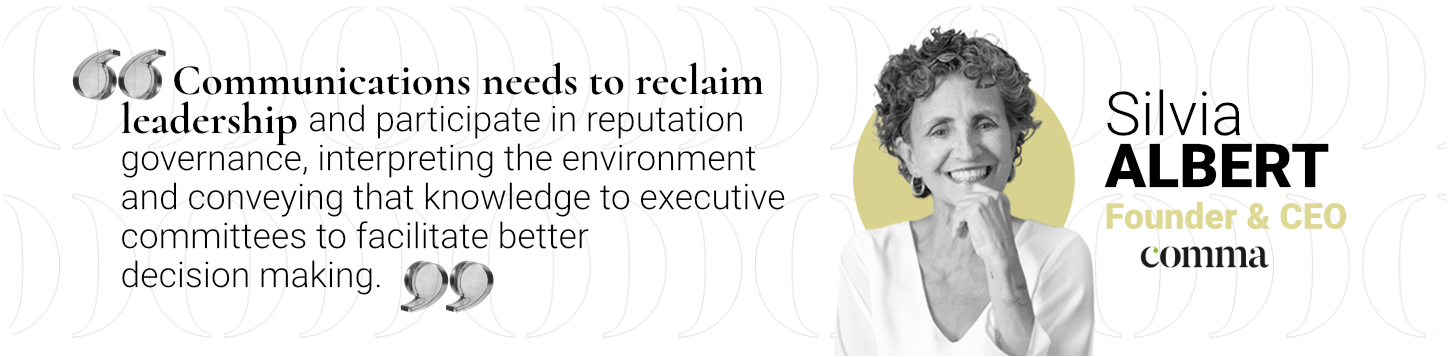
We have said this on numerous occasions, but it is worth emphasising once again. The communications department must be at the heart of discussions and decision-making that affect all stakeholders (employees, customers, investors, journalists, regulators and communities). And this can only be achieved, as both Jorge Álvarez-Naveiro and Joan Ramón Vilamitjana said in the 8th series of El elefante verde, that communication needs to regain leadership and participate in reputational governance, interpret the environment and convey that knowledge to management committees to facilitate better decisions. The new DIRCOM Board also emphasised this point, stating that the profession needs to regain influence in the forums where business strategy is defined.
We have work to do. Claiming that space requires a much better understanding of the business, interpreting the context and contributing a perspective that is useful when there is still scope to amend decisions. Are we ready to take it on? Are the organisations ready to listen to us?
Why are we doing what we do?
Let’s get back to the influencers. The controversy sparked this summer by the participation of Erola Jons in La Vuelta has sparked an discussion about the limits of these collaborations. Carlos de Andrés criticised harshly some of its content, but he added a nuance which I think much more interesting than the scandal: I understood that La Vuelta wanted to use an influencer to reach out to other audiences.
The question, then, should be directed at the organisation. What did it want to achieve? To reach people who don’t normally follow cycling? To rejuvenate its audience? To spark conversation? To generate views? Only then can we ask ourselves whether the choice, the briefing, the established parameters and the content helped to achieve this.
Mario Jiménez Arroyo summed it up recently in the headline of an article: “The problem isn’t the influencer, it’s you”. An influencer, a press release, TikTok, LinkedIn, an event, a podcast or a campaign involving UGC are options that we choose to achieve something. Marta Rodríguez Ruiz argued on our podcast that influencers, micro-influencers and UGC can coexist when each one plays a role within a single strategy. Holy strategy, so necessary and so forgotten.
And perhaps this is also a good opportunity to reconsider what we mean by success. Do we want followers or a community? Visits or readers? Virality or understanding? Engagement or trust? Impact or influence? We measure many things simply because we can measure them, but there are many others that we do not. This term, we could ask ourselves how many of these really help us to know whether we’re achieving what we set out to do.
Who and how is receiving our message?
For years, this question had answers that were relatively straightforward: customers, employees, journalists, shareholders, regulators, institutions… Then came search engines, social networks and algorithms. Now we have another intermediary: artificial intelligence.
Someone might want to find out who our company is, what its reputation is, what problems it has faced or what its customers think, and ask an AI directly. They may never visit our website, read our press release or come across our LinkedIn profile. The answer will be pieced together from the traces left behind not only by our organisation, but also by others.
What does an AI find when it searches for us? From which sources does it obtain its information? Can it identify which sources are official? What old information continues to form part of our digital identity? What narrative does it construct by linking one source to another?
This means we need to broaden our concept of an audience and, in turn, the scope of our work. Our own content, the authority of our sources, traceability, consistency of information, SEO and our presence in generative environments are beginning to intersect with disciplines that, for years, we have referred to as communication and reputation management. It is clear that we must stop treating them as separate spheres and start managing the information that others – whether people or machines – use to shape our reputation.
Is it necessary to say it?
We live surrounded by an infinite capacity for production of content. We can publish more, more quickly and at lower cost; keep constantly social media updated; create videos, images, reports, articles, newsletters, posts and opinions with a level of ease unknown until now. Do we also have the ability (or is it courage?) to stop?
In June I wrote about our tendency to have an opinion on everything, reacting to everything and living stuck in a constant debate. At that time I was talking more about ourselves as citizens than as professionals. The question applies equally to organisations: do we have anything to contribute to this conversation?, does it help anyone?, does it strengthen a relationship?, Does it explain something that deserves to be understood or is it simply noise? But… what would happen if we didn’t say anything today?
Truth, responsibility and usefulness. Perhaps those three criteria were never actually Socrates’ own, but they have proved very useful in helping us to put the new academic year, which is just beginning, into perspective. We return with many questions and, for the time being, we do not have all the answers. Or perhaps we do, but we are simply afraid of them.